New · Models directory + benchmarks
The dataset and modelintelligence layer.
Datacrawlr indexes every dataset and every open or commercial model worth knowing about — schemas, licenses, benchmark scores, pricing, and the link between the two. Metadata only. We point you to the source.
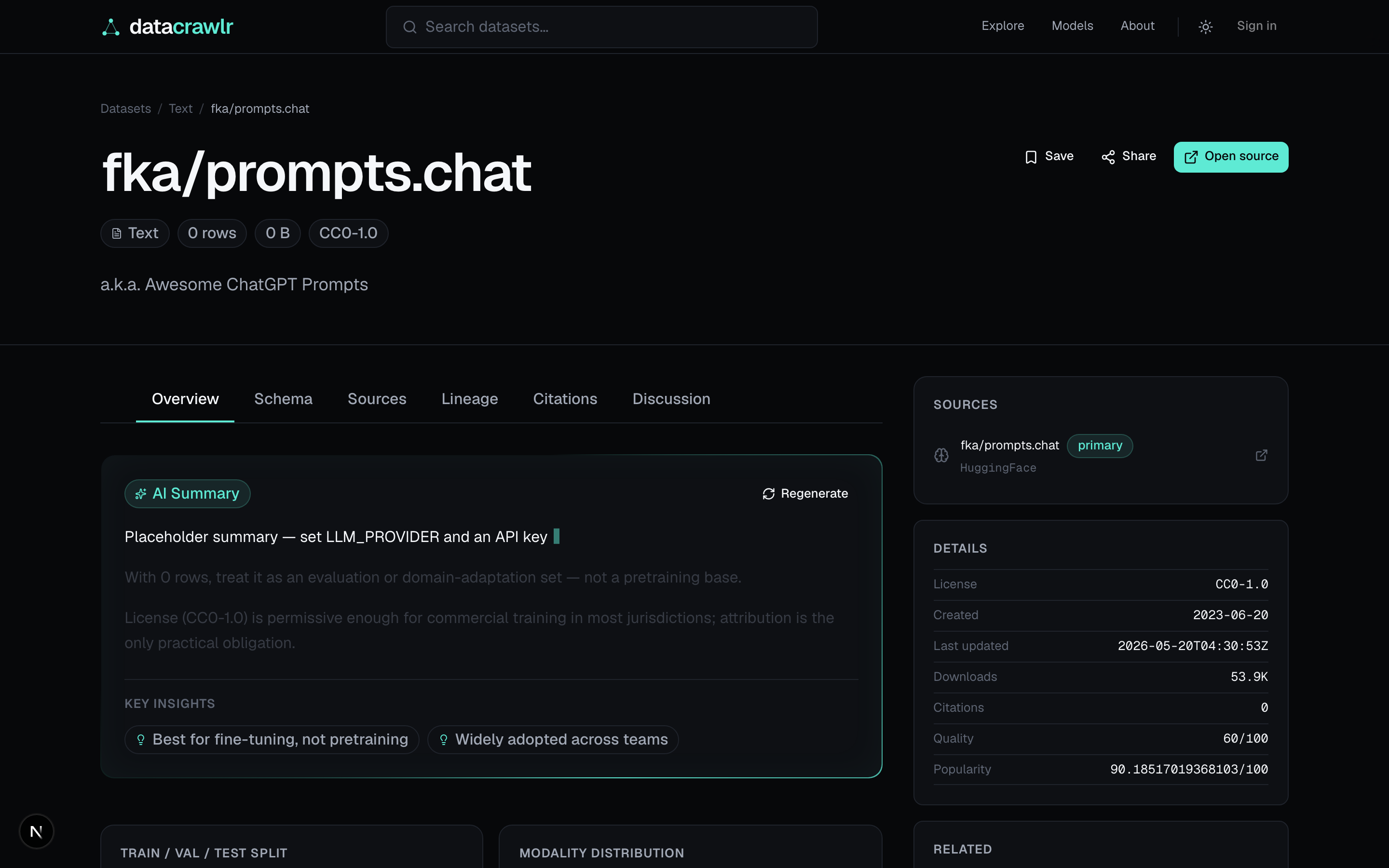
datacrawlr.com/datasets/hf-meta-llama-llama-4-maverick
- —
- Datasets indexed
- 9
- Dataset sources
- —
- Models indexed
- —
- Last refreshed
The problem
The open ML ecosystem is fragmented.
HuggingFace knows about HuggingFace, Kaggle knows about Kaggle, every government portal knows about itself. There's no single place to ask which dataset should I train on, and which model should I use it with? So engineers default to whatever's most discoverable, not whatever's right for the problem.
Datacrawlr is the discovery layer that closes the loop — datasets and the models trained on them, in one searchable index.
Search
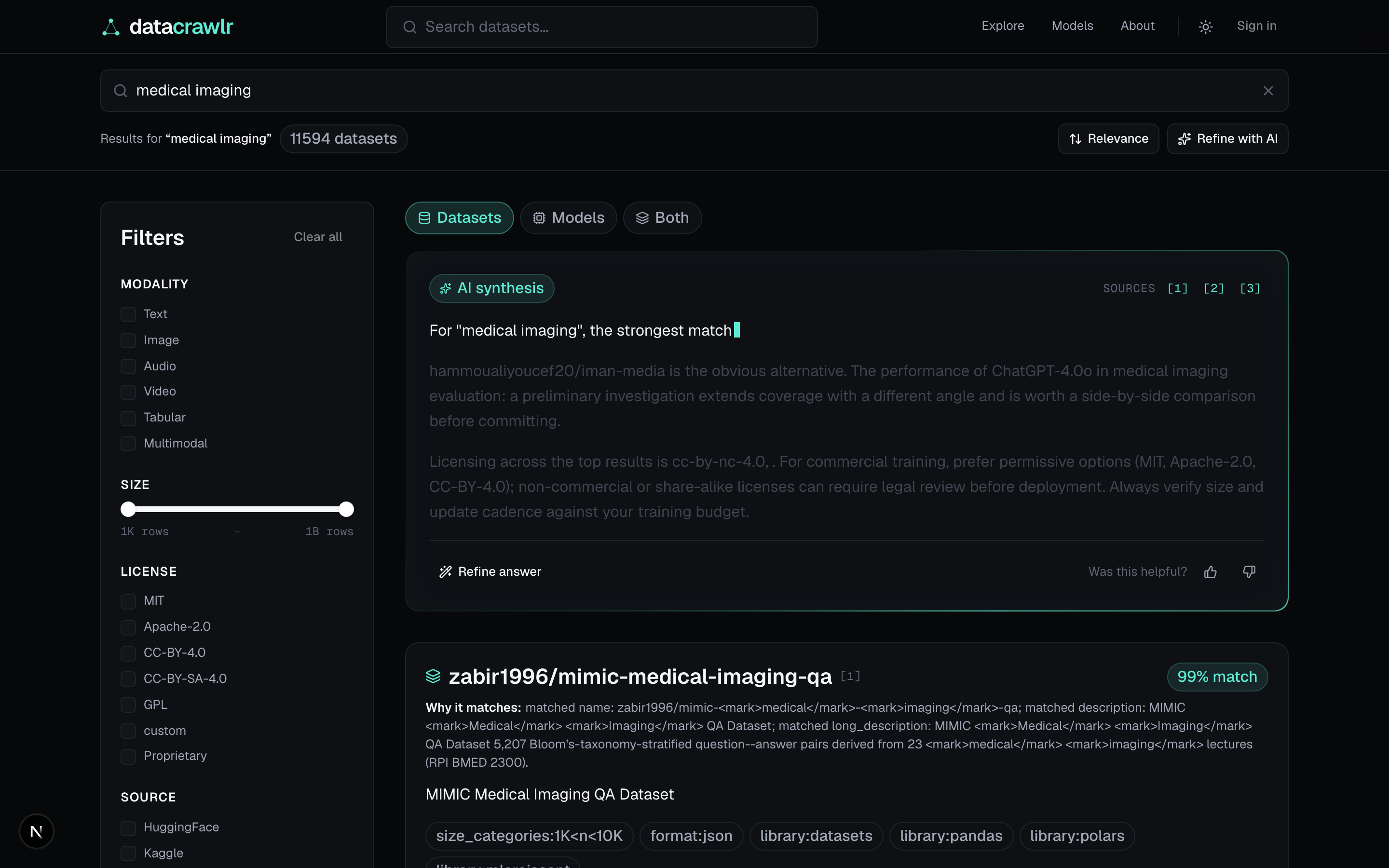
Semantic search with AI synthesis.
Type-ahead suggestions while you type. Full-text search across every indexed entry. An AI synthesis card at the top of every result page explains what the matches share and what to actually pick — with citations back to the underlying datasets.
- BM25 over OpenSearch with vector similarity for related entries.
- Filters by modality, license, source, and freshness.
- Free-tier results respect the same ranking as paid ones.
datacrawlr.com/search?q=medical+imaging
The model-dataset graph
See what was trained on what.
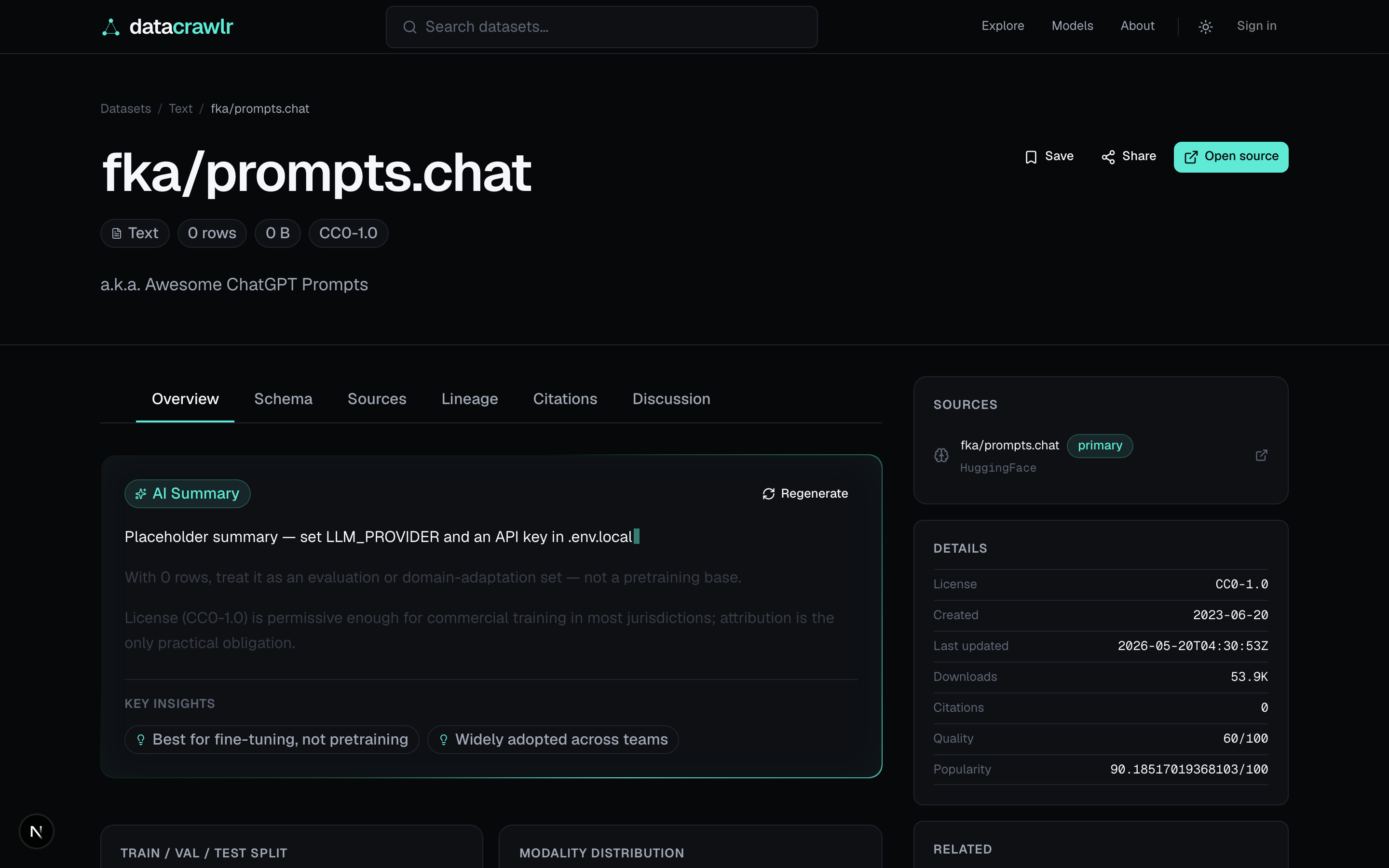
When a model card declares its training data, we connect them. Open a dataset and see which models were trained on it. Open a model and see what it learned from. This is the layer that turns Datacrawlr from a directory into an index of ML provenance.
- Trained-on / fine-tuned-on / evaluated-on, with confidence per link.
- Bidirectional: every dataset surfaces its downstream models.
- Lineage edges between related datasets where source platforms expose them.
datacrawlr.com/datasets/<slug>
Models directory
Every model worth knowing about.
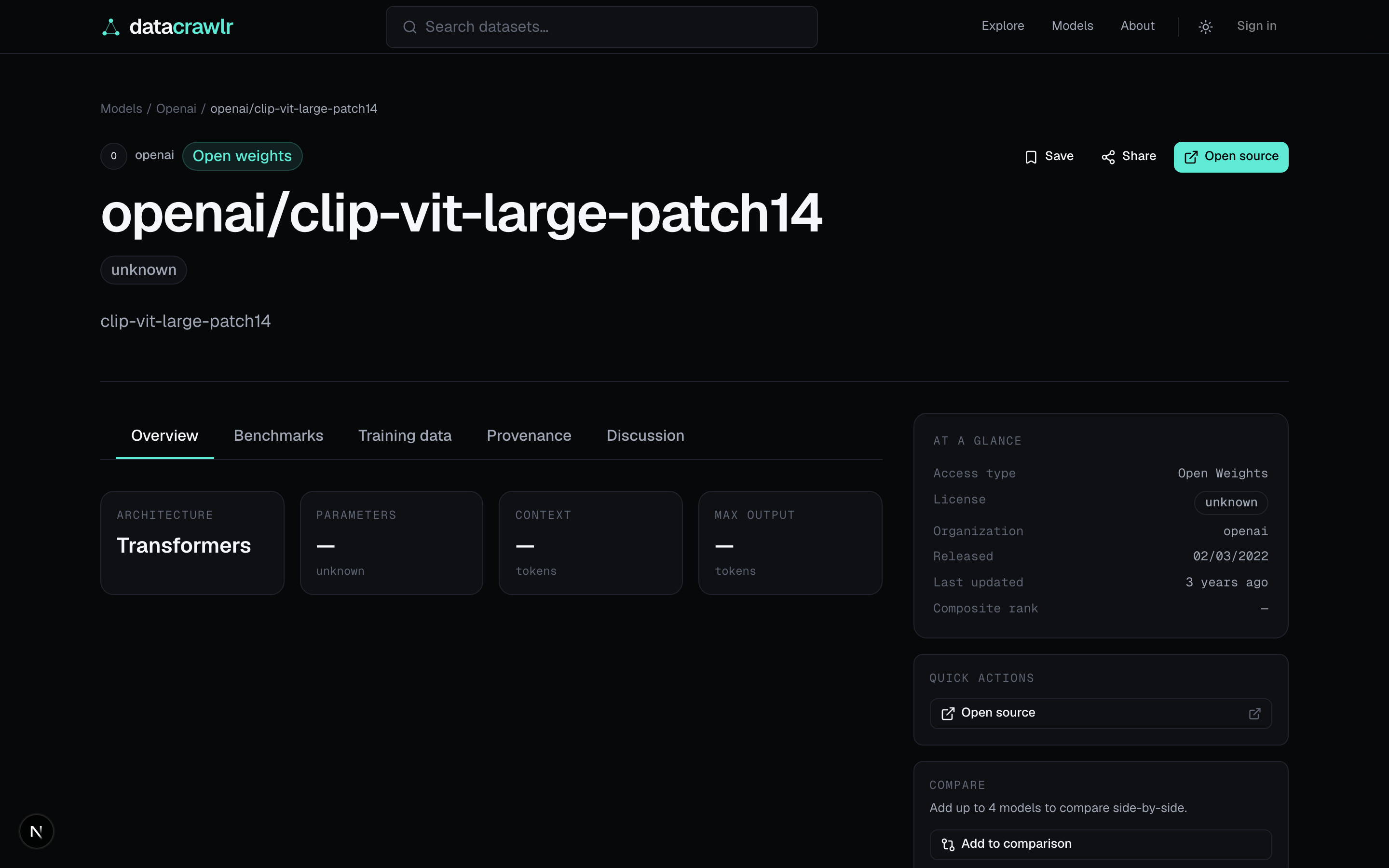
Open-weights and commercial. Benchmark scores normalized across the Open LLM Leaderboard, vendor reports, and Chatbot Arena. License risk pills, per-token pricing, context windows — and a leaderboard surface for every benchmark we track.
- Filter by access type, organization, parameters, license, and modality.
- Composite score blends MMLU-Pro, GPQA, HumanEval, MATH, and IFEval.
- Side-by-side comparison up to four models.
datacrawlr.com/models/<slug>
Explore
Every angle on the catalog.
Modality, ML task, source, license, freshness — and now models. The Explore dashboard slices the index by what you care about, so you can answer 'what's actually in here?' without typing a query.
- Donut breakdowns by modality and license type.
- Per-source health and refresh cadence.
- Trending + freshness rails reflect the last index pass.
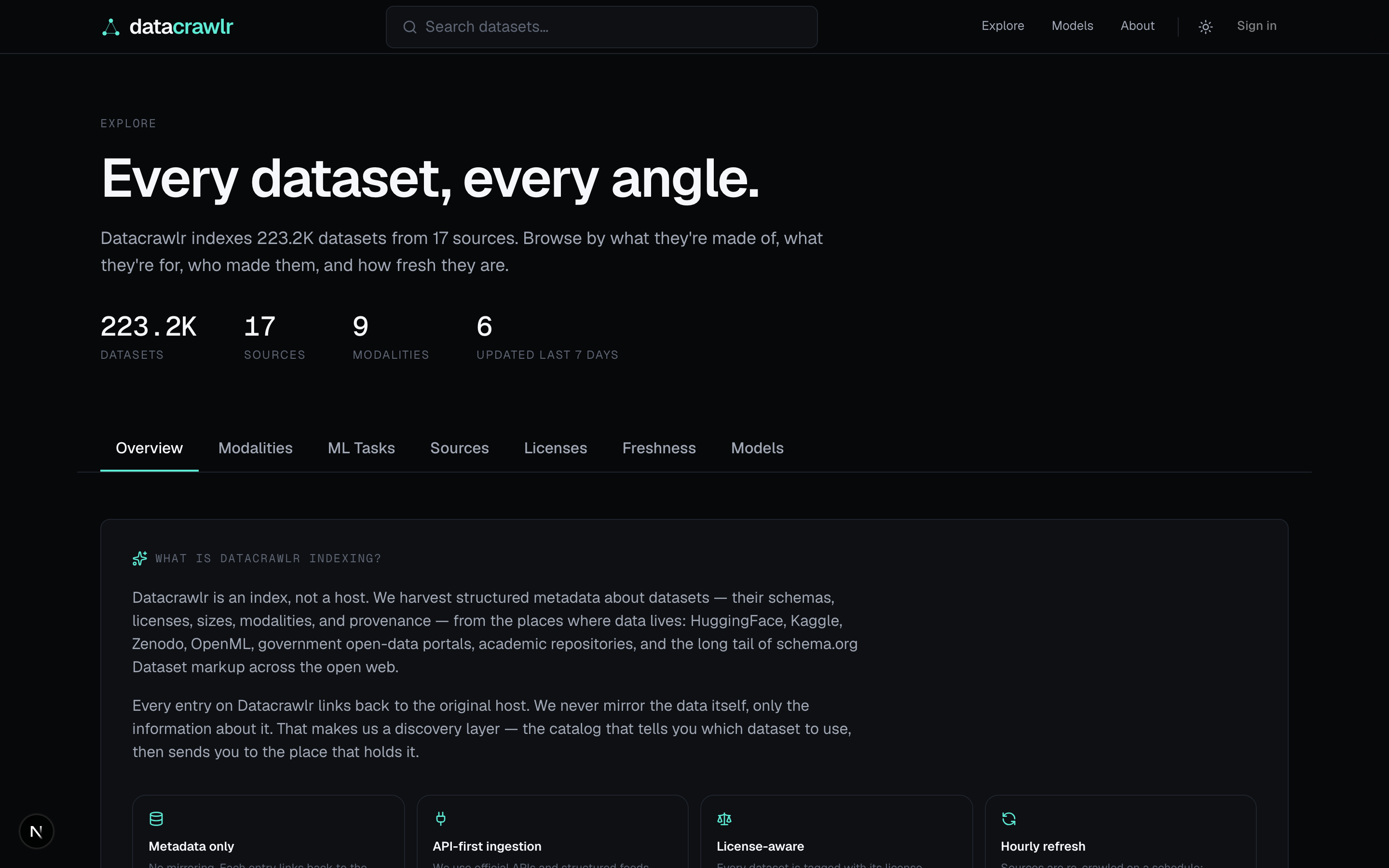
datacrawlr.com/explore
Where we index from
Every connector uses an official API or structured feed — never scraping behind auth.
HuggingFace Datasets
Largest open hub for ML datasets — community uploads and benchmarks.
huggingface.co/datasets
OpenML
Research-grade tabular ML datasets with rich schema metadata.
openml.org
Zenodo
CERN open research repository — peer-reviewed datasets with DOIs.
zenodo.org
Kaggle
Competition datasets and community contributions.
kaggle.com/datasets
CKAN portals
Government open-data catalogs — data.gov, EU Open Data, +.
data.gov +
figshare
Research outputs with DOIs and persistent storage.
figshare.com
Harvard Dataverse
Federated academic repository network.
dataverse.harvard.edu
GitHub (datasets-as-repos)
Project repos shipping CSV/JSONL/Parquet alongside training code.
github.com
Schema.org / DCAT
Structured metadata across the open web — institutional + long tail.
schema.org/Dataset
HuggingFace Models
Largest open registry of model weights, configs, and cards.
huggingface.co/models
OpenRouter
Unified pricing + provider catalog for commercial-API models.
openrouter.ai
Compliance posture
Index, don't mirror.
Our architecture is the compliance story. Four commitments that apply to every entry in the catalog.
API-first ingestion
Every connector hits the source's official API or a structured open feed (DCAT, OAI-PMH, schema.org). We never scrape behind authentication or paywalls.
Metadata only — no mirroring
We index what a dataset or model is — not the bytes themselves. Every page links to the original host; the host stays the source of truth.
License-aware by default
Each entry is tagged with its license category and use terms. License risk badges surface non-commercial and restrictive terms before you build on them.
Robots.txt + rate limits respected
Identified User-Agent. Backoff on errors. Crawl-delay honored. Where a source publishes quotas, we stay well under them.
Stop bookmarking datasets and models.
Explore the code on GitHub to see how it works.