Datasets
Every dataset worth knowing about.
Datacrawlr harvests structured metadata from nine sources of open data — research repositories, ML community hubs, government portals — and projects every entry into a single canonical schema. You compare them like rows in a database.
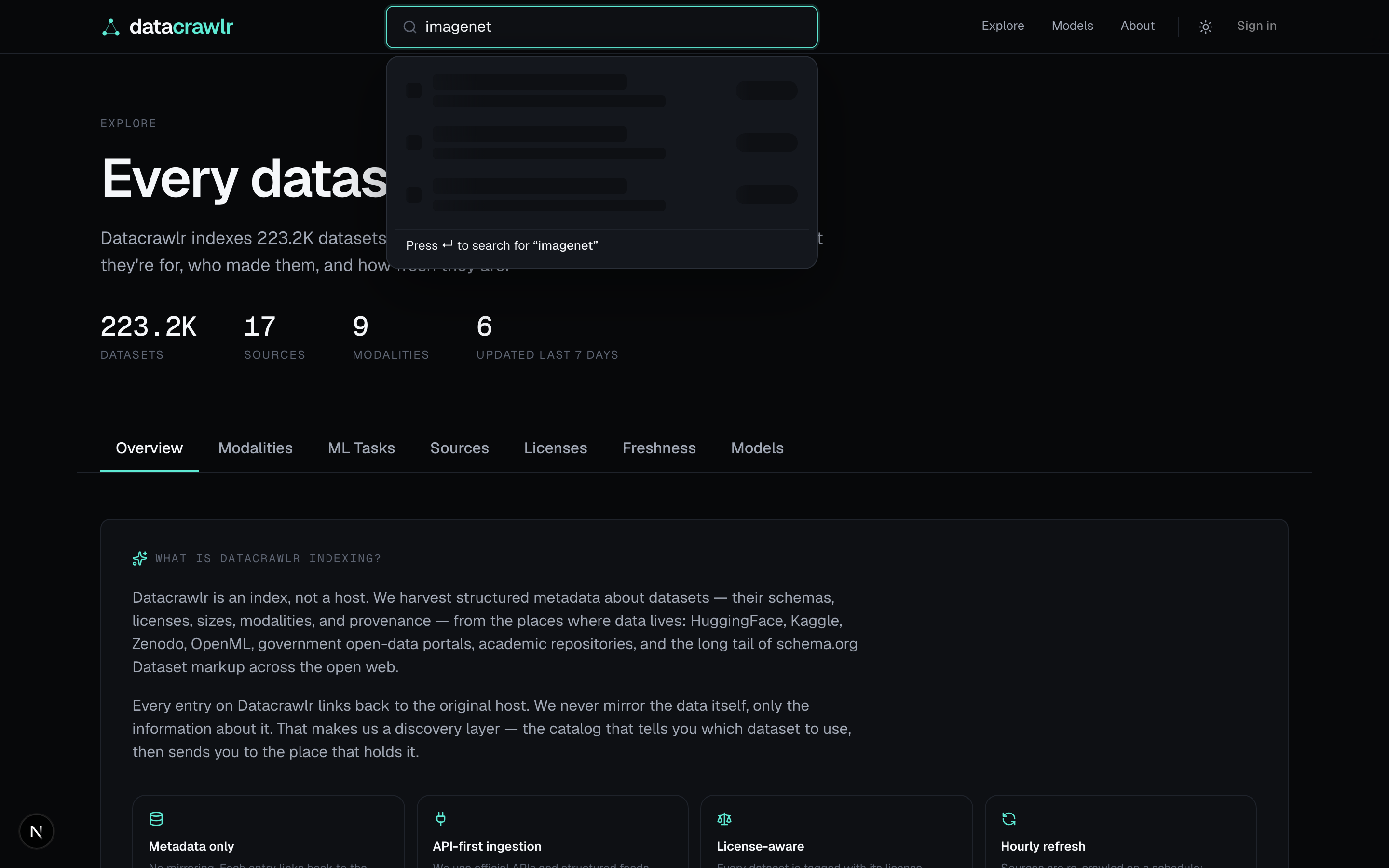
Discovery
Type two characters. See what we have.
The hero search runs against every indexed dataset and model. Two-line previews per row. Hit enter for the full search page with AI synthesis and faceted filters.
datacrawlr.com
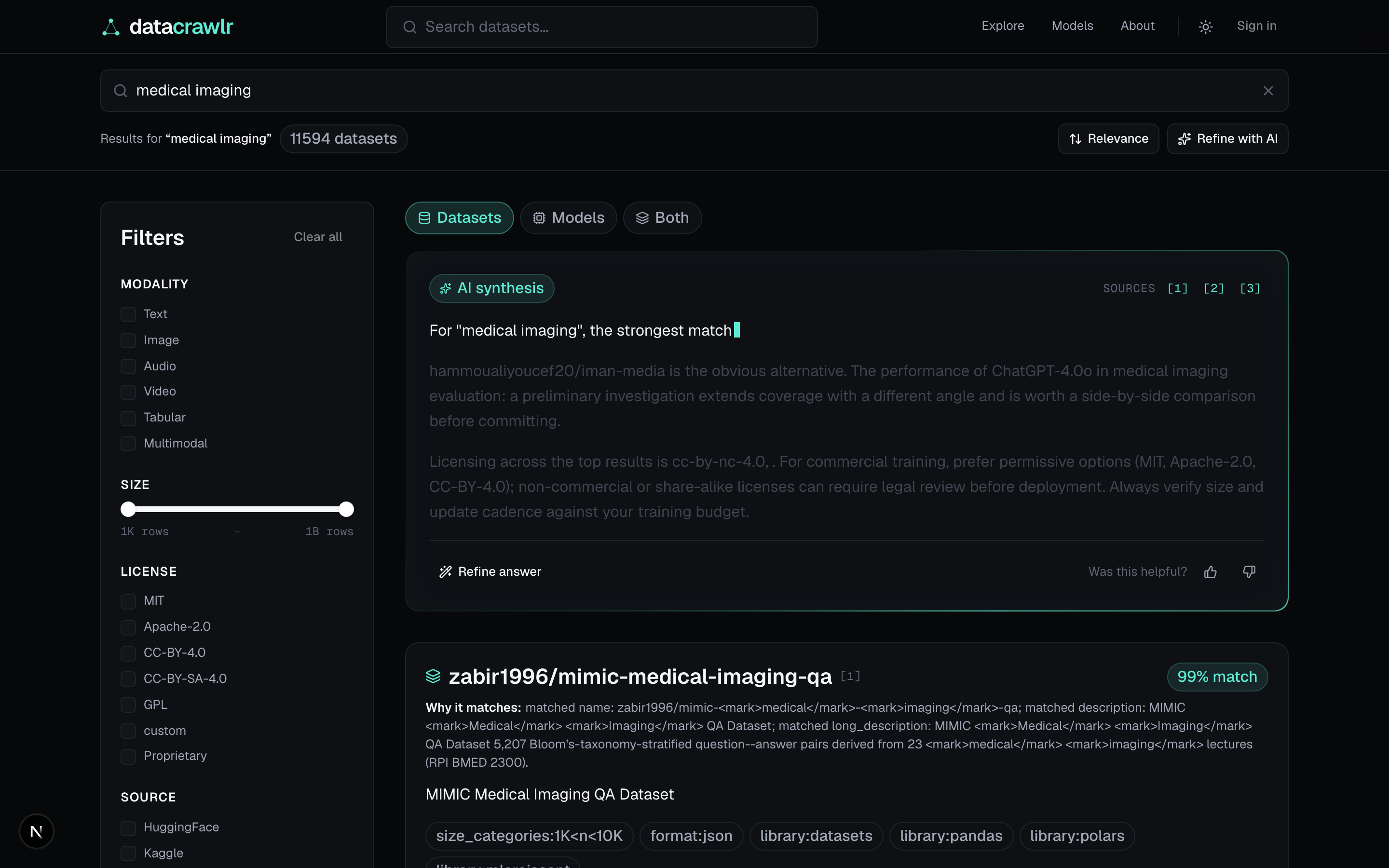
Search + synthesis
An AI summary at the top of every result list.
Searches return real datasets ranked by BM25 + popularity. The synthesis card above the grid explains what the matches share, where they differ, and which to start with — with citations back to the actual rows.
datacrawlr.com/search?q=medical+imaging
What we capture
Four metadata layers on every entry.
Every dataset is described by the same fields regardless of where it came from — so cross-source comparisons actually work.
Schema + structure
Field names, types, descriptions, and nullability — parsed from source-platform feeds where available, inferred from sampled rows where not.
License + use terms
Normalized license category (permissive / copyleft / non-commercial / restrictive / proprietary / public domain), commercial-use signal, and a risk pill.
Lineage + provenance
Derived-from / similar-to / benchmarked-against edges between datasets, plus the models that report training on them.
Citations + attribution
BibTeX-quality citation strings when the source publishes them, creator credentials with ORCID when known.
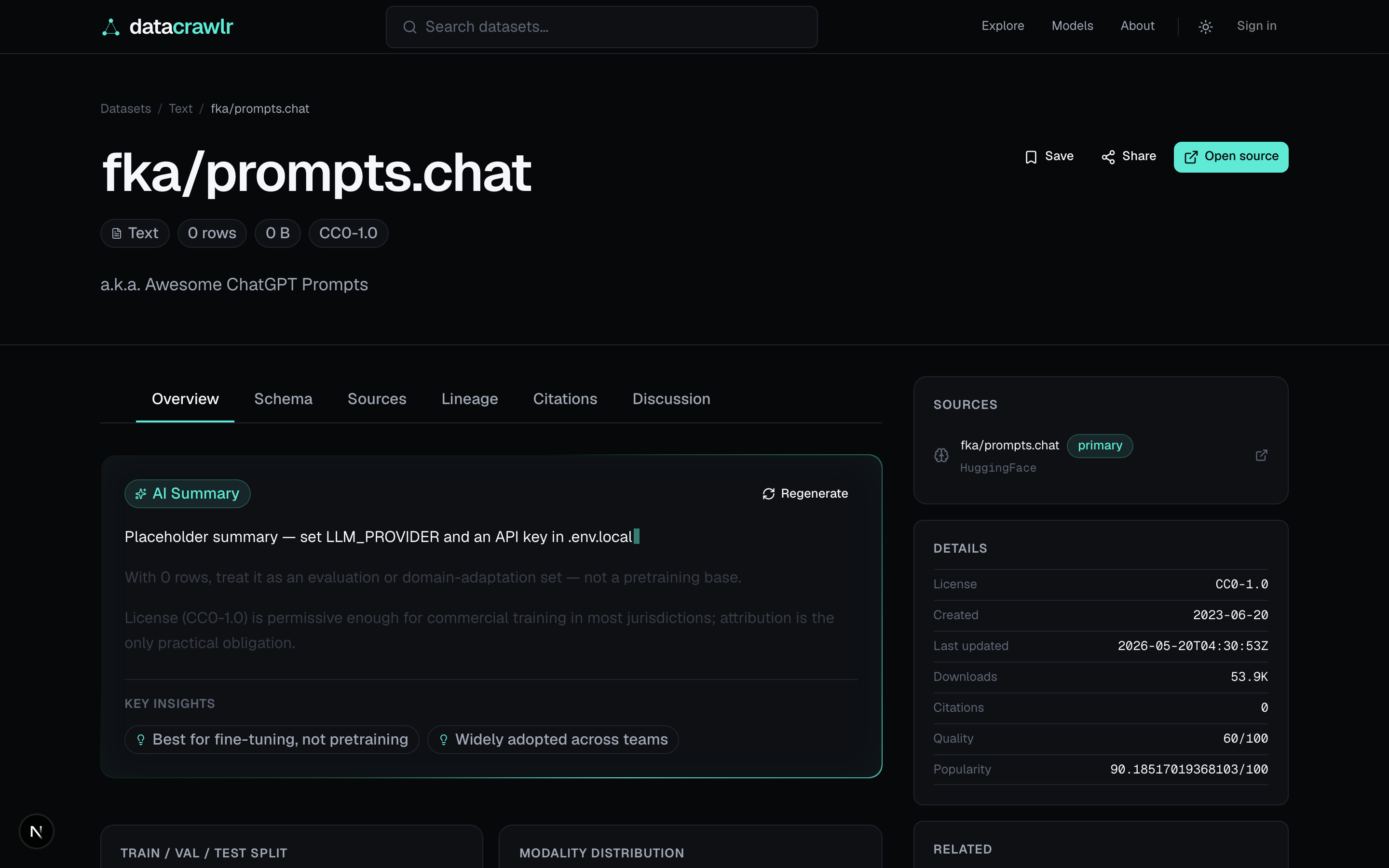
Detail page
The dataset page is the work product.
Six tabs cover everything you need to make a build/skip decision: overview with AI summary, schema viewer, source attribution, lineage graph, citations, and a per-dataset discussion thread.
- License risk pill prevents you from building on non-commercial data by accident.
- Lineage tab links derived-from / similar-to / benchmarked-against datasets.
- Models trained on the dataset surface as a rail in the overview.
datacrawlr.com/datasets/<slug>
Nine dataset sources, official APIs only
Every connector hits the source's published API or a structured open feed. No scraping behind authentication.
HuggingFace Datasets
Largest open hub for ML datasets — community uploads and benchmarks.
huggingface.co/datasets
OpenML
Research-grade tabular ML datasets with rich schema metadata.
openml.org
Zenodo
CERN open research repository — peer-reviewed datasets with DOIs.
zenodo.org
Kaggle
Competition datasets and community contributions.
kaggle.com/datasets
CKAN portals
Government open-data catalogs — data.gov, EU Open Data, +.
data.gov +
figshare
Research outputs with DOIs and persistent storage.
figshare.com
Harvard Dataverse
Federated academic repository network.
dataverse.harvard.edu
GitHub (datasets-as-repos)
Project repos shipping CSV/JSONL/Parquet alongside training code.
github.com
Schema.org / DCAT
Structured metadata across the open web — institutional + long tail.
schema.org/Dataset
Compliance posture
Index, don't mirror.
Our architecture is the compliance story. Four commitments that apply to every entry in the catalog.
API-first ingestion
Every connector hits the source's official API or a structured open feed (DCAT, OAI-PMH, schema.org). We never scrape behind authentication or paywalls.
Metadata only — no mirroring
We index what a dataset or model is — not the bytes themselves. Every page links to the original host; the host stays the source of truth.
License-aware by default
Each entry is tagged with its license category and use terms. License risk badges surface non-commercial and restrictive terms before you build on them.
Robots.txt + rate limits respected
Identified User-Agent. Backoff on errors. Crawl-delay honored. Where a source publishes quotas, we stay well under them.
Honest about what we are
Datacrawlr indexes metadata, not bytes. Every dataset page links back to the original host; we never mirror, cache, or redistribute the underlying data. License classifications are a starting point for discovery — not legal advice. Verify on the source before commercial use.
Find the right dataset without bookmarks.
Explore the code on GitHub to see how it works.