Models
Every model worth knowing about.
Open-weights from HuggingFace, commercial APIs from OpenRouter and the major vendors, benchmark scores from the Open LLM Leaderboard and Chatbot Arena. One catalog, the same shape for every row.
Directory
A directory that respects how you actually pick.
Sort by composite score, parameters, newest, popularity, cheapest output cost, or largest context window. Eight quick-filter chips for the common slices — frontier open-weights, free tiers, multimodal, code-focused, latest releases.
- URL-synced filter strip — share a view by pasting the link.
- Hover-only 'Compare' button on every card.
- Composite score weighted across MMLU-Pro, GPQA, HumanEval, MATH, IFEval, and Arena ELO.
datacrawlr.com/models
Benchmarks
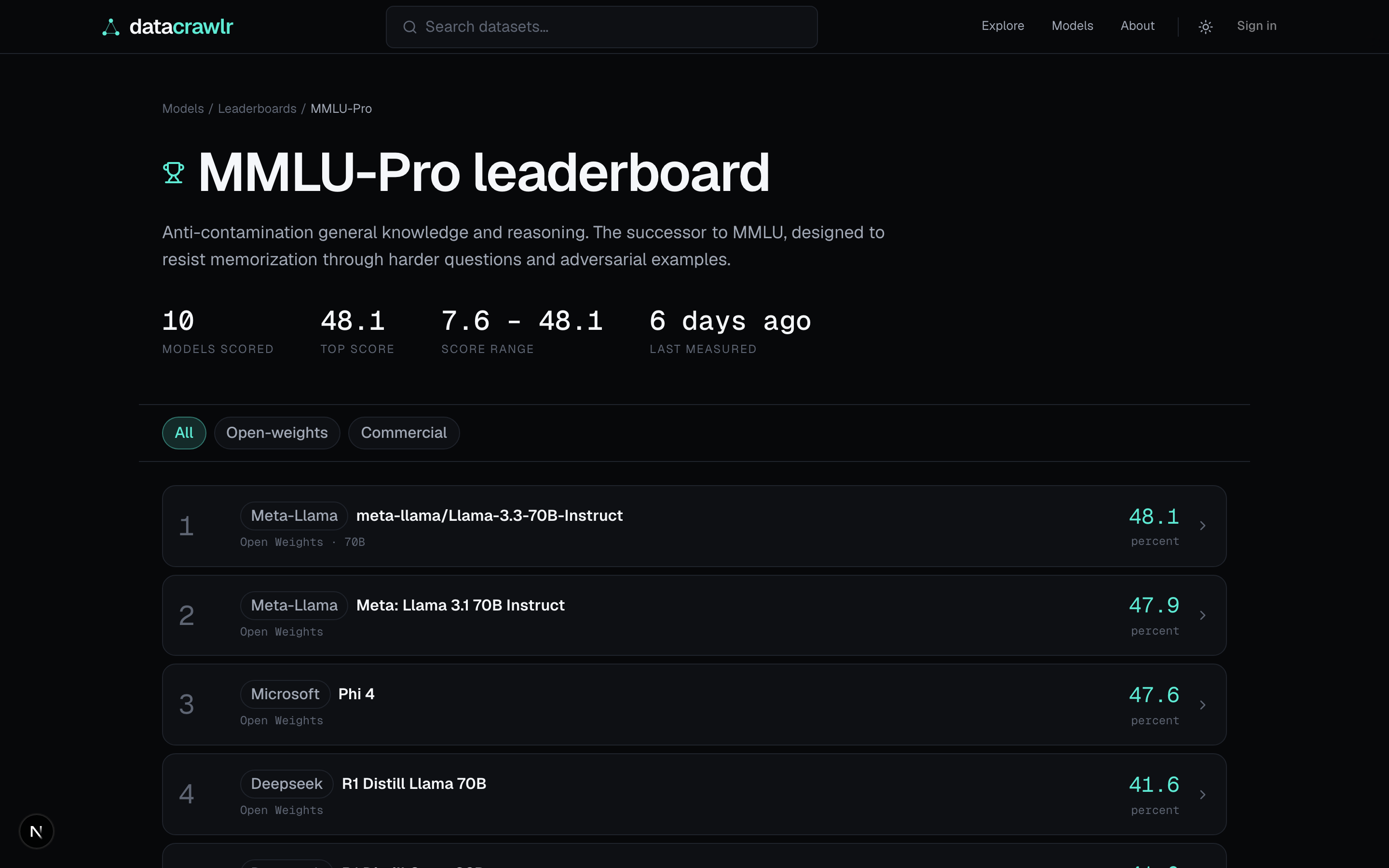
Normalized, sourced, and honest about the limits.
Each benchmark page links the methodology, surfaces score format (% accuracy / pass@1 / ELO), and flags the source (Open LLM Leaderboard / Artificial Analysis / Vendor-reported / Paper-reported). The trust callout reminds you that public benchmarks are a signal, not the only signal.
datacrawlr.com/models/<slug>
What we track per model
Four axes that actually drive decisions.
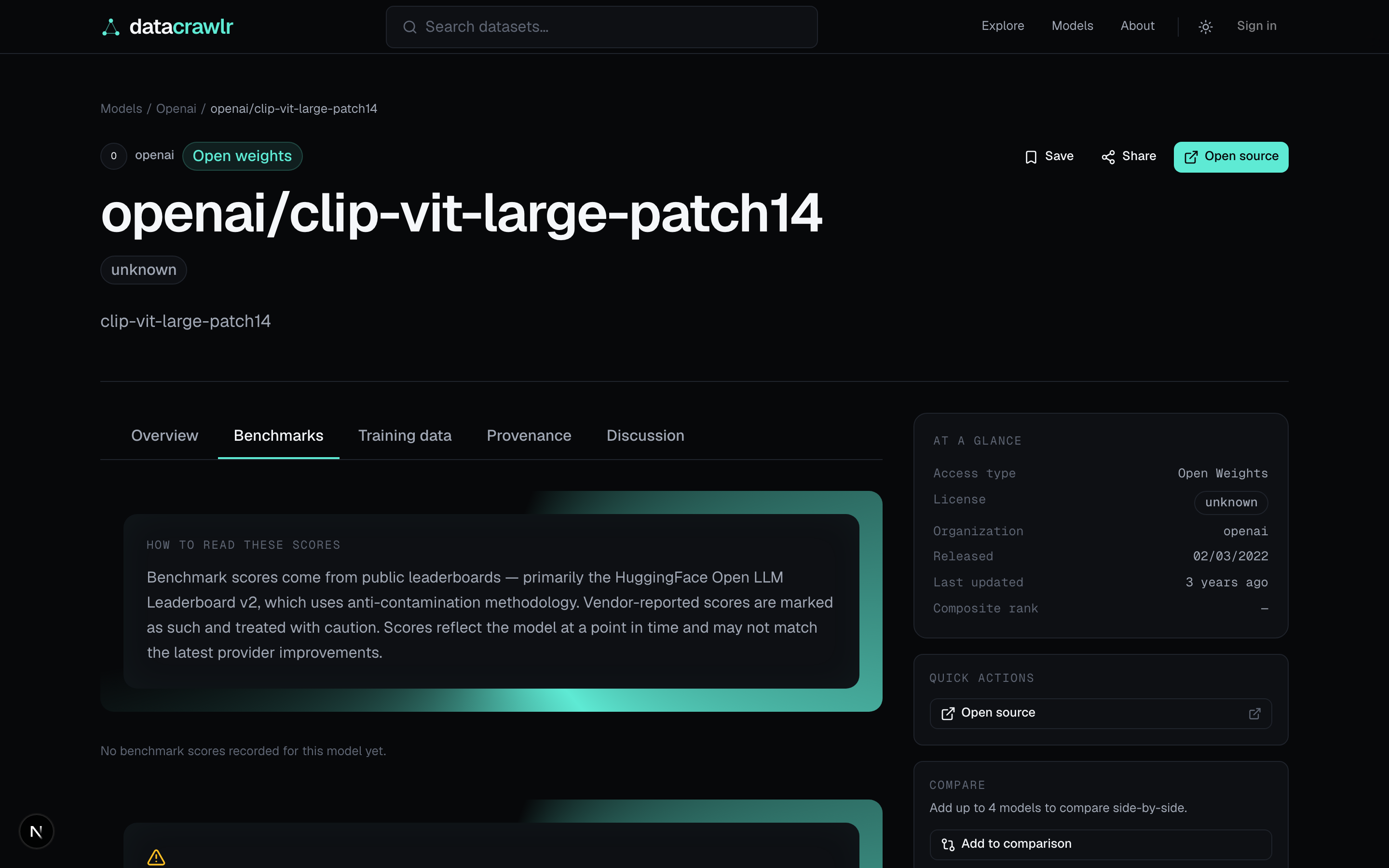
Benchmark transparency
Twelve benchmarks tracked, with their source labelled on every score. Vendor-reported scores are flagged so you know what to trust.
Pricing without lookup spreadsheets
Per-million-token input/output cost on commercial APIs, plus a calculator that compares your usage mix against the cheapest alternatives.
Side-by-side comparison
Stack up to four models across identity, architecture, benchmarks, pricing, and provenance. Highest score wins each row.
License risk you can scan
Every license is classified into a risk band (low / medium / high) with commercial-use, attribution, redistribution, and modification flags.
Provenance
The link to the data.
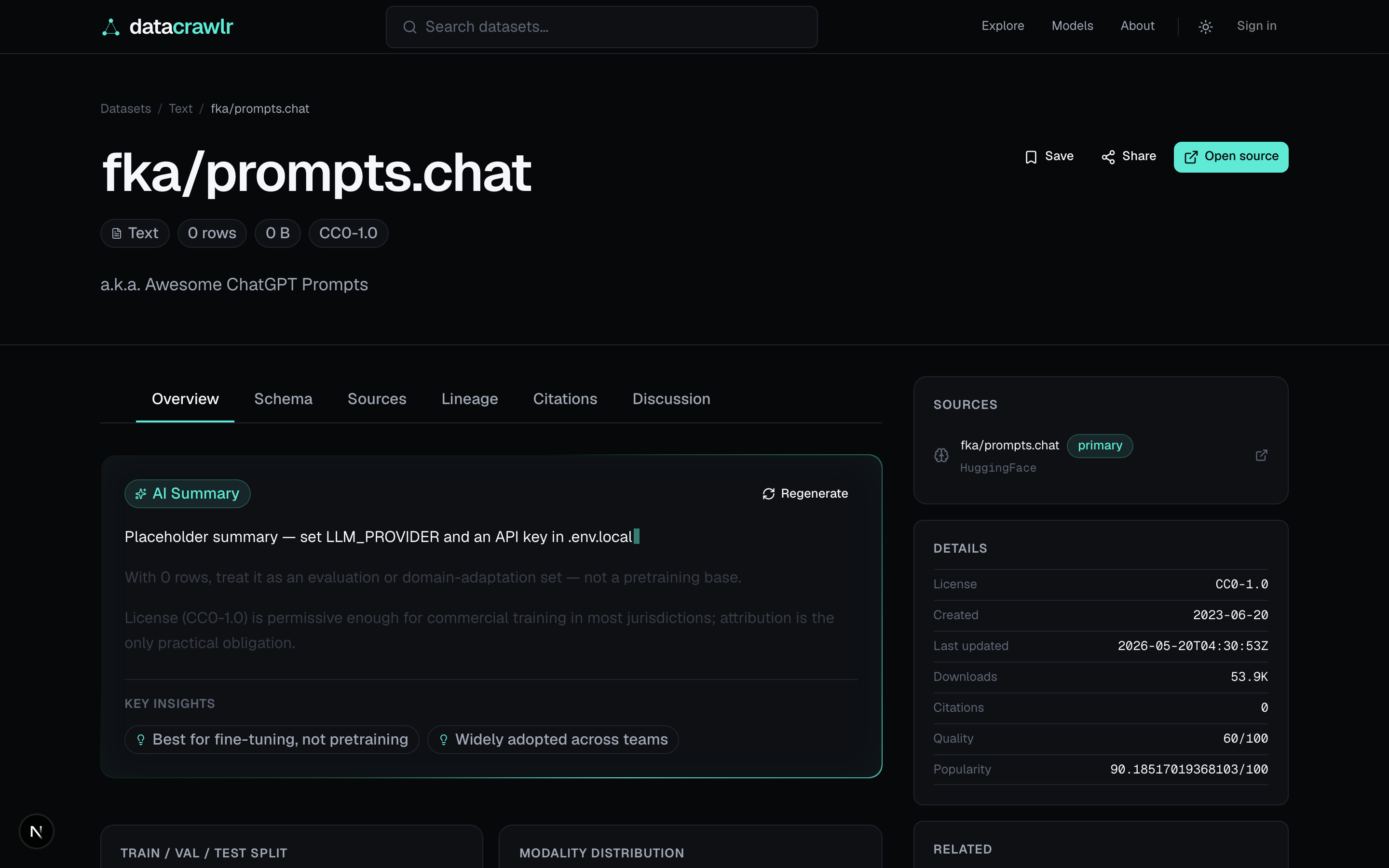
Every model's training-data declarations are indexed. Open a model and see the datasets it was trained or fine-tuned on. Open a dataset and see which models picked it up. That bidirectional link is the layer that turns this into provenance, not just listing.
- Trained-on / fine-tuned-on / evaluated-on, with per-link confidence.
- Cross-page navigation in both directions.
- Inferred links are explicitly labelled as such — never silently surfaced.
datacrawlr.com/datasets/<slug>
Compare
Four models, every dimension.
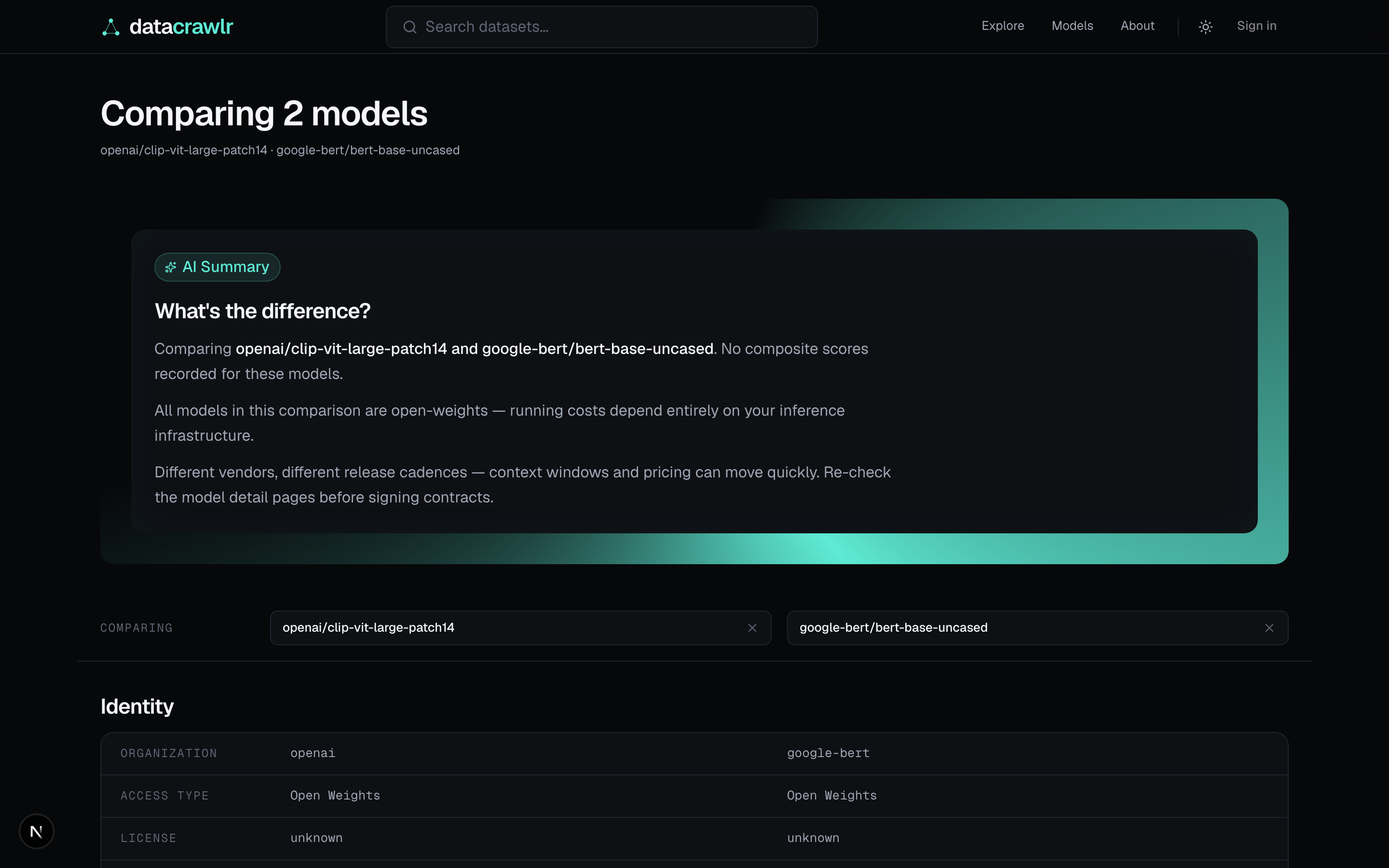
Add models from the directory or the detail page. The comparison view stacks Identity, Architecture, Benchmarks, Pricing, and Provenance — with the winning value in each row highlighted by a left-border accent and an AI summary card up top.
- Cheapest output cost wins the pricing row.
- Highest score wins each benchmark row, with per-cell mini bars.
- AI insight card up top summarizes what's actually different.
datacrawlr.com/models/compare?ids=<a>,<b>
Two model sources, official feeds only
HuggingFace for open weights, OpenRouter for the commercial pricing + provider catalog.
HuggingFace Models
Largest open registry of model weights, configs, and cards.
huggingface.co/models
OpenRouter
Unified pricing + provider catalog for commercial-API models.
openrouter.ai
Compliance posture
Index, don't mirror.
Our architecture is the compliance story. Four commitments that apply to every entry in the catalog.
API-first ingestion
Every connector hits the source's official API or a structured open feed (DCAT, OAI-PMH, schema.org). We never scrape behind authentication or paywalls.
Metadata only — no mirroring
We index what a dataset or model is — not the bytes themselves. Every page links to the original host; the host stays the source of truth.
License-aware by default
Each entry is tagged with its license category and use terms. License risk badges surface non-commercial and restrictive terms before you build on them.
Robots.txt + rate limits respected
Identified User-Agent. Backoff on errors. Crawl-delay honored. Where a source publishes quotas, we stay well under them.
Benchmarks aren't the whole story
Public benchmarks are subject to contamination, methodology drift, and overfitting. For production decisions we recommend running a private holdout evaluation on prompts that match your actual workload. Datacrawlr is the place you start that decision — not the place it ends.
Pick the right weights without spreadsheets.
Explore the code on GitHub to see how it works.